Time to think differently about off-shore investing?
Time to think differently about off-shore investing?
Over the years many South Africans have gone to great lengths to externalize assets and create overseas investment portfolios, often at high cost. But does this still make sense?
The desire of South Africans to invest offshore is often driven by fears that local laws and restrictions could mean that your family assets built up over a lifetime may become trapped in South Africa or become devalued over time compared to US Dollars. South Africa still has real problems, however steady changes to our regulations have addressed many of the issues that concerned investors decades ago
Exchange controls have been significantly
Exchange control, which was very strictly applied prior to 1994, has been progressively relaxed. In 2026 under the Single Discretionary Allowance, South African resident adults can transfer up to R2 million per calendar year for permissible purposes like travel, study, donations, or offshore investments without requiring a tax clearance certificate. In addition to this you can transfer an additional R10 million per calendar year for offshore investments with SARS approval.
International diversification is now easy to do
Diversifying investments internationally makes sound financial sense, but in the past South African investors had limited options to do so. Since the early 1990’s investment legislation has been progressively modernized so that today under Reg 28 of the Pensions Act, even retirement investments have up to 45% offshore exposure.
Leading unit trusts in South Africa hold a large portion of their assets in international markets, (up to 45%) so just by utilising these local funds investors gain substantial exposure to international companies and global markets without having to incur the costs of externalizing their funds.
Another aspect to consider is that for decades South Africa’s largest companies have actively expanded their operations around the world to such an extent that today it is estimated that the top 40 companies on the Johannesburg Stock Exchange have 72% of their earnings exposed to foreign currencies.
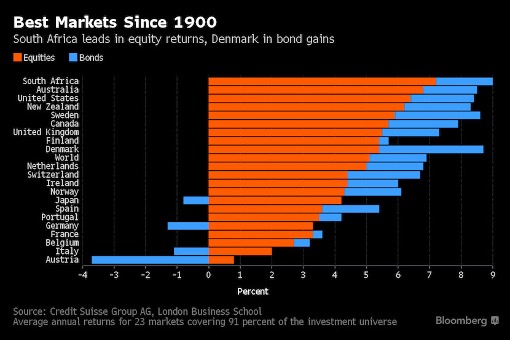
It is widely believed that offshore investments will provide better returns than South African investments. While there are certain periods that this holds true, it does not do so over the long term. Research by Credit Suisse shows that the South African stock market has provided the best real returns in the world over more than 100 years.
Investors are often not aware that owning international assets such as property, shares and funds creates the potential liability of additional costs and taxes. SITUS taxes of up to 40% are levied on the death of investors who own assets which are located in the USA, UK and other popular jurisdictions.
Offshore costs and taxes can destroy hard-won gains
Inheritance taxes may also entail expensive and lengthy probate expenses in each jurisdiction to which the South African investor is exposed. On the other hand, South African legislation in the investment arena is comparable to the most advanced economies which ensures that low-cost investments are freely available at home in South Africa.
While off-shore investments may still have a place in your portfolio, it is essential to discuss with your financial adviser the more negative aspects such as potentially higher costs and taxation, as well as your family’s circumstances and long term financial objectives before committing to an off-shore strategy.

